

By Bridget Bell, founder of Pumpkin · Published

When we talk about teaching kids "goals," the conversation almost always slides straight to money - save up for the thing, hit the dollar amount. Saving is a wonderful goal. But if the only goals a child ever sets are about buying something, we quietly teach them that the point of effort is stuff. In Pumpkin, a goal doesn't have to be a dollar amount. It can be about giving, growing, or contributing - and those goals often mean the most.
Money is one kind of goal, not the only one
A savings target is a great place to start: it's concrete, it teaches patience, and the payoff is real. Keep those. Just don't stop there. Once a child has felt what it's like to set something, work toward it, and reach it, that same muscle works for almost anything worth doing - not only things you can buy.
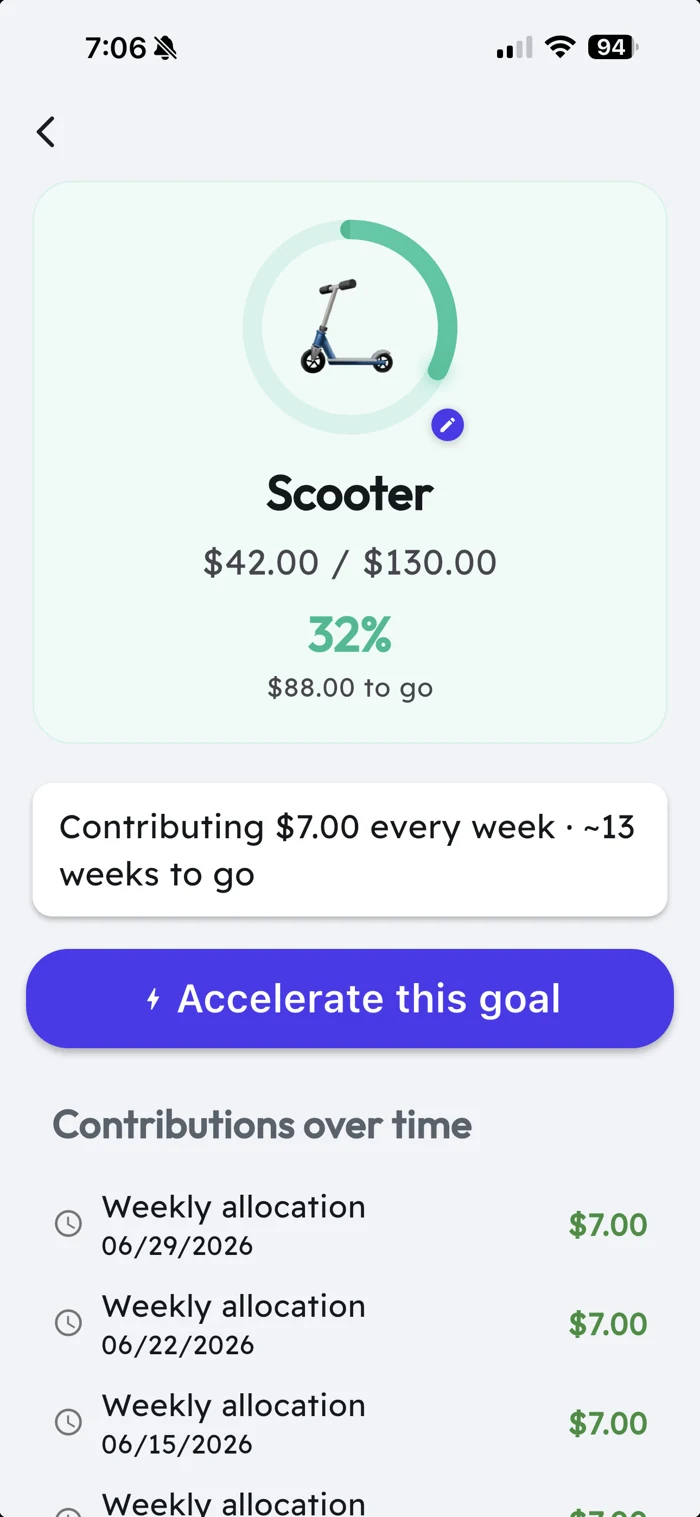
In Pumpkin, every goal is measured one of three ways - in money, in points, or simply in words - so a goal can be a dollar amount, a points target, or something that has nothing to do with money at all.

What your child sees
What you see
Goals that give back
Some of the most powerful goals point outward. You can frame a goal around contributing to something bigger than a shopping list:
- A giving goal. Pumpkin has a whole "Giving" goal type - "I am giving to..." - for things like collecting coats for a shelter or gathering items for a food drive. Your child names it, adds a picture, and updates how far along they are as they go.
- A helping-out goal. Volunteering at a shelter, a community garden, or a neighbor's yard works as a word-based goal: describe it in your child's own words and move the progress along together.
- A kindness goal. Donating a portion of what they earn, or a run of good deeds, turns generosity into a habit rather than a one-off.
These goals teach that effort can be aimed at other people, and that contributing feels good in a way a purchase rarely matches.
Goals for growing
Plenty of great goals are about the child themselves - not giving, not buying, just growing:
- A school goal - "I am working towards..." a grade, a reading target, a project finished on time.
- An activity goal - "I am training for..." a race, a recital, a personal-best on an instrument or a sport.
- A skill or milestone - a new recipe, a level reached, anything your child decides matters to them.
Why goals beyond money matter
Non-money goals build the parts of character a dollar target can't. A giving goal grows generosity. A growth goal builds intrinsic motivation - doing something because it matters, not because there's a payout. And every goal, money or not, teaches the same underrated skill: follow-through. Setting something, sticking with it, and finishing is a muscle, and the more kinds of goals a child practices on, the stronger it gets.
How to set a good one
Whatever the goal, the recipe is the same:
- Make it your child's, not yours. A goal they chose is a goal they'll chase.
- Make it concrete. "Be kinder" is hard to track; "collect coats for a shelter" is something your child can name, picture, and move forward.
- Make the progress visible. A goal you can watch move is a goal that keeps its pull. Break big goals into small steps.
- Celebrate reaching it - and then set the next one. The habit is the real prize.
Curious how goals fit with the rest of the system? See how Pumpkin works, or read how the Family Patch Shop handles the money side of saving toward something.
The takeaway
Teach a child to chase a savings target and you've taught them to save. Teach them to set goals of every kind - giving, growing, contributing - and you've taught them that they can decide what matters and go get it. That's a lesson worth far more than the contents of any jar.
